
The most influential reviews.
The standard of the music industry since 1999.
Teddy Swims Is Letting Himself Be Brutally Honest On 'I've Tried Everything But Therapy'
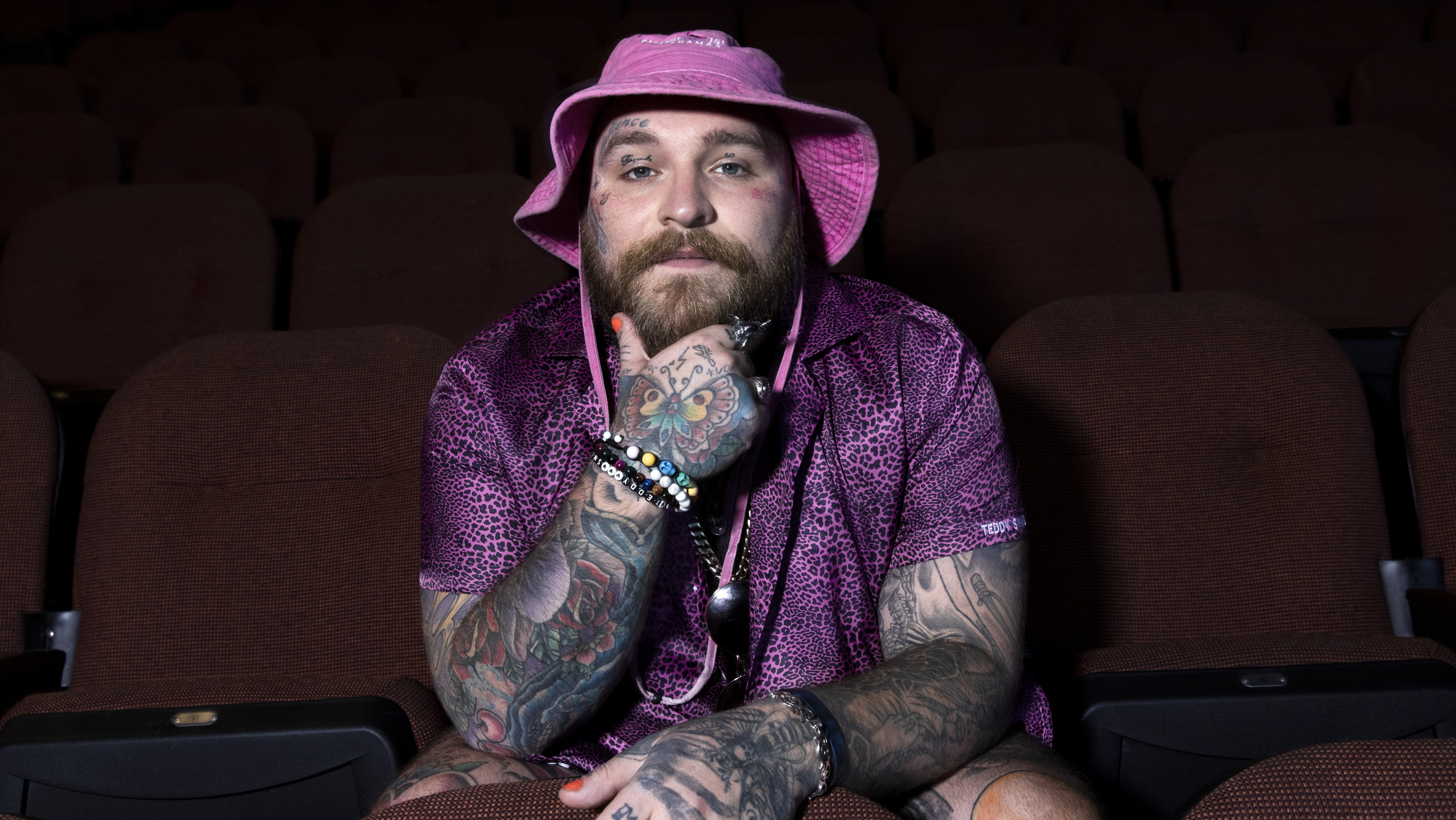
Four years into his career, Teddy Swims made a promise to himself to be more honest. With that in mind, he decided to be unflinchingly real with his debut album title: I've Tried Everything But Therapy.
While the title may be true for now, Swims is incredibly vulnerable. Across 10 tracks, he divulges the raw emotions of heartbreak, from reeling over what could've been in opener "Some Things I'll Never Know" to leaning into new love — while still in repair — on closer "Evergreen."
"It's the most honest I've ever let myself be," Swims, born Jaten Dimsdale, says of the album. "I'm proud of it, and I'm proud of myself. And it's a f—ing relief to just get it off my shoulders."
For someone who bares his soul in his music, both lyrically and vocally, it's rather surprising to think that he wouldn't be the type for therapy. But now that the album is out, his next step is seeking professional help — another promise he made to himself upon choosing the candid title.
In the meantime, Swims is already seeing the impact of being more and more open in his music. "Lose Control," the album's lead single, has earned Swims his first entry on the Billboard Hot 100 and first solo radio hit (in 2022, his Meghan Trainor collab "Bad For Me" reached No. 15 on Billboard's Adult Pop Airplay chart). But perhaps more notably, his powerful vocal runs on the song's dynamic chorus are stopping listeners in their tracks. As one YouTube commenter put it, "Man has a voice that speaks to the core of your soul."
Just before the album's arrival, Swims talked with GRAMMY.com about how I've Tried Everything But Therapy has helped him understand the impact of wearing his insecurities on his sleeve — and how his bewitchingly soulful voice ties it all together.
How does this album feel different from what you've put out before this, whether it's lyrically or sonically, or even how you feel mentally based around the process?
I feel like this is maturity. I can listen to these songs and I feel proud of them.
Everybody kinda doesn't like their own voice, you know? But I feel like I belong on those songs, and nobody could say what I needed to say the way I could say it. I feel like I'm saying something that I need to say and get off my chest in an entirely different way than I ever have.
I'm kind of an emotional toddler. I'm getting more of a grasp on what I want to say and how to say it, how to talk about my feelings more. I feel like the more I do it, the longer I do it, the more honest I become, the more I get out of the way of things. I'm learning to get out of the way and let the creative flow just be what it is now.
Going into writing this album, like, what were you going through? And did you have a goal in mind about what you wanted the album to be?
I really didn't know at the time. In the last four years, I've written maybe four or five hundred songs. I didn't write it knowing that it was an album, or write it knowing that this was going to be the album; but more so, when it started coming together, it just felt like things fell into place.
I realized that I've been circling around the same feelings and emotions for a very long time. It's always about — I was in a very toxic relationship, and I have been a lot in my life. This is me kind of learning that I can be loved, and that I am beautiful, and I deserve love. That's kind of what the struggle is and always has been.
The album title is interesting to me, because so many artists compare songwriting to therapy. But has songwriting always felt like therapy for you?
Songwriting can be therapeutic if you have a feeling that you need to get out, and you write that feeling down, and you get it out. But what I tend to do a lot in my life, I'll write it down into a song, and then I'll write it into another song from a different perspective. And I'll write it down 100 different ways, in 100 different perspectives, to the point that it ends up that that small problem has now turned into the biggest problem in my life, because I've thought about so many different ways.
Instead of being more therapeutic, [songwriting has] been more of a way of highlighting what I'm going through, sometimes way too much.
The title itself was kind of a promise to myself that I would go to therapy when the album comes out. I think it's something that everyone can benefit from, especially me. But there's still something about me — maybe it's a generational mindset, like, I'm not crazy, I don't need that, or maybe there's answers to questions I don't really want to ask that I'm gonna get.
I like my coping mechanisms. I like how I am and who I am when I do cope. So there's a part of me that's afraid that I'll have to change.
But I made a promise to myself, put a deadline on myself where I'll go and I'll seek help, and I'll try. It's also me being honest and open about that, to you and to everyone, that I'm like, "I need help, that's okay." I'm gonna ask for help, and that's a liberating and equally terrifying thing.
The nice thing is, there has been a lot more public acceptance of mental health in recent years. How have you felt that change since you started releasing music, and how has it impacted your songwriting?
I think what's so great about our industry these days is that I'm not held to the same standard as, like, Stevie Wonder or Michael Jackson, where I have to be such a star, and you don't know anything about me. These days, as an artist, I get to be absolutely insecure and absolutely terrified, and it's what makes my artistry beautiful. And people that feel the way I feel can look at me and say, "That guy's so insecure, and he's so scared. But he's doing it, and we want him to win."
I don't want to swallow my insecurities. I don't have to wait until I feel like I'm worthy of love to put myself out there. Every bit of insecurity, and everything that's going on in my life, I'm allowed to just wear it and put it on for everybody to see. That has helped me in more ways than me trying to be anything I'm not.
You've said that for a long time, you worried about giving too much of yourself in your music, but seeing people connect to the music has made you realize it's actually making a difference. When did you start realizing that?
I am very lucky — every show we do, I have a meet and greet where I can talk to 100 people, and they tell me things that have changed their life, ways that I've affected them, and the ways that I've touched their lives.
I also want them to know that I'm just that fat kid from Rockdale County, Georgia, and still feels like that. And they make me be able to be honest and have an outlet to turn my trauma into something positive in me.
I feel like I learn it more and more every day that I am in a safe space, and I've created a safe space for people, and I become safer in that all the time. And I'm becoming more honest with myself, with them, in the safe space. It's just sacred, you know?
Was there a song of yours that kind of opened that up for you, because of the way that people connected to it?
I've had a few like that, but "Simple Things" that I released on one of my EPs is still a song I sing all the time. I thought the verses were only specific to my life and what I was going through — that was the first time I was honest, and I wrote from only what I was going through specifically to my life, and that connected and did more for people than anything I did [previously].
You've said that you're insecure, but would you consider yourself an introvert?
I think the more that I do this, the more I become one. I used to be the biggest extrovert in the world, but the more I do this job, the more I have to be social, I feel myself becoming more of an introvert.
Well, I brought that up because so many artists consider themselves introverts, when you are pouring your heart out in music that is then heard by thousands, if not millions, of people. Has that dichotomy ever crossed your mind?
Yeah, but that's kind of why I think I've become more introverted, because I gotta figure out what's still mine or if there should be anything that I should hold to myself. That is the question: What is still for me, or should there still be anything just for me?
That's so interesting to think about — I've never really thought about the battle that an artist can have when they share so much. Because it's like, at that point, you're so exposed, how are you even supposed to function as a private person in any regard?
Yeah. You figure it out, you let me know. [Laughs.]
It's cool that you're feeling so proud of this album, though, because I'd say that means that you haven't gone too far.
It's the most honest I've ever let myself be. And I don't feel exposed — I just feel like I said what I needed to say.
I've heard that I've Tried Everything But Therapy is coming in multiple parts and this is just part one. Is that true?
Yeah, we're planning on part two, but I don't know what that looks like yet. But I want to put out more music. And I think I want to come from a different place of what I've learned from how I've healed. I just don't feel like this story's done yet.
But you said you're going to start therapy after this album releases — so you're going to release a part two of I've Tried Everything But Therapy after you've been in therapy?
Yeah, I guess that doesn't make sense. But it will!
It would be kind of interesting to have part two be the response to therapy after you have done it.
Yeah, exactly. That's the vibe. Maybe we just go straight to part three and skip part two altogether.
Before you even released part one, people were going crazy over "Lose Control" because of how soulful you sound on it. When did you realize you had such a captivating voice?
It wasn't really a realization — I was bad for a long time. But I love this, and I wanted this, so I worked hard to become good at it. I wanted to be the best I could at it, because using my voice means everything to me, and I want to know how to do everything I can with it.
Well, you're doing something right, because people are exclaiming about it left and right. I saw a comment on one of your Instagram posts that said, "I just threw my shoe across my damn office, you better sing!" Do you feel the power of your own music?
I know, technically and dynamically, I am a good singer. When I listen to myself, I can't say I can't sing, because it's all there. Any singer or vocal coach could tell "That kid knows what he's doing. He can sing his ass off."
But also, there's part of me that still doesn't like my voice, too, just like anyone else. And I think that might be why I became so good at it. Because I want to hear it and be like, "Well, you can't tell yourself you ain't good, 'cause that was f—ing — that takes skill." I've learned enough to know that I can't tell myself I'm bad. [Laughs.]
And I have to say, I've been impressed with all of the people you've posted singing their own versions of "Lose Control."
People can sing! And people have been writing verses to it too. The love on it has been so rewarding.
I feel very justified [that the music] is connecting. I feel like it's already helping. I feel very humbled, appreciated and loved.
On 'Super Over,’ Leah Kate Offers Advice On Cutting Off Toxic Relationships




COMMENTS
Leave a comment