
The most influential reviews.
The standard of the music industry since 1999.
Disiniblud
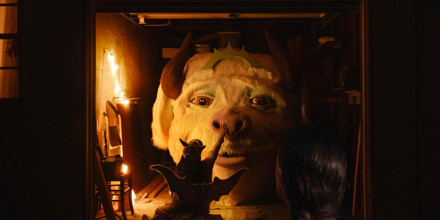
In the 1977 queer manifesto The Faggots and Their Friends Between Revolutions, author Larry Mitchell juxtaposes the fantasies of “the faggots” with those of “the men.” The men fantasize about control, domination, personal accumulation; the faggots about love, solidarity, communal embodiment. In their self-titled debut Disiniblud, composer-musicians (and self-described Larry Mitchell fangirls) Rachika Nayar and Nina Keith bring to life these queer fantasies, asking what queer utopia might feel like and how we might collectively get there.
Built on the duo’s longstanding friendship, Disiniblud (pronounced “Disney blood”) is a dreamy ode to community that weaves together electronic experimentation with subtle pop lyricism and explosive instrumentals with ambient soundscapes. It highlights the strengths within each artist’s solo music: Where Nayar’s 2022 debut full-length Heaven Come Crashing offered a transcendent mash-up of club beats and post-rock grandiosity, Keith’s 2019 MARANASATI 19111 leaned into found sound and formlessness. On Disiniblud, Nayar’s compositional rigor and Keith’s intuitive process produce an album whose moments of quiet are as pointed as they are open-ended and whose moments of rapture embrace desire as much as release.
For Disiniblud, utopia is an exercise in imagination and observation alike. On the bucolic “Serpentine,” featuring Cassandra Croft, an undulating guitar and muted piano trade looping figures back and forth, evoking the gentle rocking motion of a lullaby. Croft’s reverb-soaked vocals float atop shimmering synths, as the sun grows, a door opens, and we are launched towards the bright unknown. If “Serpentine” is a daydream, “Traces in the window” is its lunar counterpart. The haunting alto of ASPIDISTRAFLY’s April Lee, reminiscent of Grouper, narrates dark silhouettes from behind a pane: “a stray creature,” “a stanza,” “the spleen of existence.” Observation gives way to revelation and, by extension, another world.
In uncovering multiple portals to utopia, Disiniblud home in on childlike wonder—a force that permeates the entire album. On “Blue Rags, Raging Wind,” hammered figures play in rounds, recalling a toy xylophone or a music box. Meanwhile, simple keyboard melodies on tracks like “No more to see” and “whole30 Fight Club” recall the guileless piano work of ambient composer Harold Budd. Proof that “childlike” doesn’t always mean “simple,” the title track sounds like a direct descendant of Sigur Ros’s “Hoppípolla” (Icelandic for “hopping in puddles”), both in its youthful exuberance and its sweeping emotional arc. Video game blips and whirring machines propel the track skyward into a dramatic post-rock windstorm. In featuring nearly all of the album’s collaborators, including Julianna Barwick, Tujiko Noriko, and Willy Siegel of Ponytail, the track acts as a thesis statement on the centrality of community to Disiniblud’s vision of paradise.
More than anything though, Disiniblud sounds like hope. “[it could happen]” chops up and loops its eponymous mantra, as the sound of a helicopter readies for lift-off. On “It’s Change,” trills, whoops, and fluttering flutes convey humor and delight while offering a landing spot for heartbreak. Love and loss are inextricable, and Disiniblud reprise melodic motifs and vocal samples across different tracks to gesture at this dialectic. Barwick’s gauzy intonations of “give up,” for instance, float through both “It’s Change” and “Give-upping,” sister tracks that celebrate letting go. Filmic in a way that recalls Explosions in the Sky or Nayar’s own “Heaven Come Crashing,” “Give-upping” feels like standing on the precipice of a cliff before a world that is startlingly whole. Barwick’s ethereal vocals echo like a chorus from on high, as subdivisions stack up into a wall of sound. Under a single pounding piano note, a droney sub-bass beats like a Kali Malone organ, as a mechanical ratcheting recalls a roller coaster’s ascent. The ensuing drop may be vertiginous, and the promise may be unknown—but such is queer life. It is always an act of faith.
Nayar and Keith, for their part, know this well. They know that the earth, as Larry Mitchell put it, has been “scarred and gouged and stripped and bombed,” and it is time for the fairies to leave the world of men and to make one of their own. With Disiniblud, the duo have done just that. They’ve built a garden full of twinkling guitars and gossamer voices, shadowy caves and blinding light. The air is warm here, and the door is open.







COMMENTS
Leave a comment