
The most influential reviews.
The standard of the music industry since 1999.
The Saudi National Orchestra And Choir Take The Stage In Rome
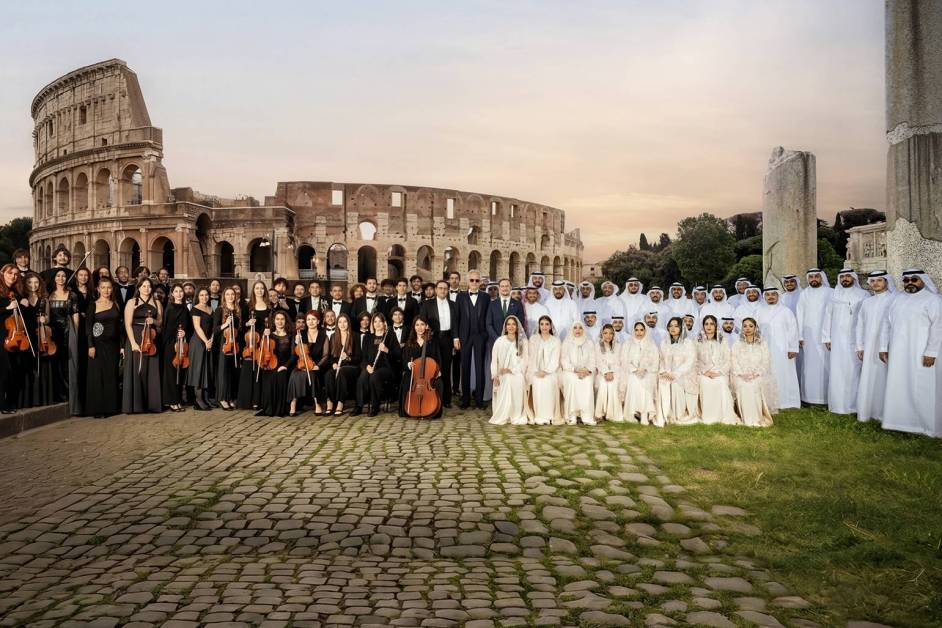
The Colosseum hardly needs anything to elevate its atmosphere. Yet on a spring evening in May 2026, it became the setting for the 11th stop of the Marvels of Saudi Orchestra world tour.
A total of 62 musicians performed at the Temple of Venus and Rome inside the Colosseum Archaeological Park, surrounded by nearly two thousand years of Roman history. Thirty two performers came from the Saudi National Orchestra and Choir, while the remaining 30 musicians represented Italy’s Fontane di Roma Youth Orchestra under the direction of maestro Marcello Rota. Joining them was legendary tenor Andrea Bocelli, marking his first performance alongside the Saudi National Orchestra and Choir. Bocelli has appeared in Saudi Arabia more than six times over the years, building a long standing relationship with the Kingdom’s growing cultural sector.
The concert arrives during a period when Saudi Arabia has firmly established itself within the global music business, emerging as a rapidly growing market investing heavily in live entertainment, music education, touring infrastructure, and broader accessibility to music creation and consumption. The Marvels of Saudi Orchestra tour has become one of the clearest international representations of that cultural shift.These large scale initiatives have continued growing since Saudi Arabia established its Ministry of Culture in 2018, followed by the creation of the Saudi Music Commission in 2020.
“Performing against the magnificent backdrop of the Colosseum is always a deeply moving experience,” Bocelli said about the event. “But sharing this stage with the Saudi National Orchestra and Choir made it even more meaningful. Music has the power to connect cultures across time and space, and this performance was a beautiful expression of that connection. It was a privilege to be part of a performance that brought together such rich musical traditions in the heart of Rome.”
Since debuting internationally in Paris during 2022, the Saudi National Orchestra and Choir has steadily expanded its touring history. The ensemble has performed in Mexico City, New York’s Metropolitan Opera, London’s Central Hall Westminster alongside the Royal Philharmonic Orchestra, the Sydney Opera House, Tokyo Opera City, and later returned to Paris for a performance at the Palace of Versailles. The orchestra also staged two concerts in Riyadh at King Fahd Cultural Center, appeared at AlUla’s Maraya Hall, and has now added Rome’s Colosseum Archaeological Park to that growing list.
Every stop on the Marvels of Saudi Orchestra tour has followed a clear artistic approach. Rather than only presenting Saudi repertoire abroad, the ensemble directly engages with the musical identity of each host city. In New York, the orchestra opened with Fly Me to the Moon arranged around the ney, a traditional Arabic reed flute. In London, they blended Rolling in the Deep with the Saudi classic “Adeet fi Marqab” alongside the Royal Philharmonic. During the Tokyo performance, the group introduced Arabic language renditions of Japanese anime theme songs. Audience reactions consistently went beyond simple appreciation because these arrangements were carefully designed with each local audience in mind before the performances even began.
Rome offered an entirely different challenge. As the birthplace of opera and a country deeply rooted in classical tradition, Italy carries exceptionally high musical expectations. That made the Saudi Orchestra’s collaboration with Bocelli one of the tour’s most symbolically important moments so far. Performing beside a tenor who has appeared at Olympic opening ceremonies placed the Saudi ensemble in front of an audience shaped by centuries of established musical standards.
Maestro Marcello Rota, who guided both orchestras through a program spanning Saudi, Italian, and international compositions, reflected on the collaboration from a conductor’s perspective. “Bringing together the Saudi National Orchestra and Choir with the Orchestra Giovanile Fontane di Roma has been a deeply rewarding artistic experience,” he explained. “As a conductor, what is most striking is both the shared musical understanding and the distinct character each tradition brings. There are clear differences in style and expression, but also strong similarities in discipline, emotion and musicality. These compositions, whether Saudi or Italian, find a natural dialogue when performed together. In that exchange, the orchestra becomes a single, unified voice while still preserving the richness of its individual parts. That is where the true artistry lies.”
Beyond the Bocelli collaboration, the Rome concert featured a specially curated program blending Saudi and Italian medleys built around beloved mainstream and classic songs from both nations, along with performances highlighting Saudi traditional performing arts.
One of the evening’s standout moments came through an original Saudi Music Commission composition titled “Al Hijr and Rome,” inspired by a Roman inscription discovered at Al Hijr, Saudi Arabia’s first UNESCO World Heritage Site located in AlUla. The composition reflected centuries old cultural ties between Saudi Arabia and Italy while continuing the Saudi Music Commission’s tradition of creating original works tailored specifically for each tour destination.
The Saudi National Orchestra and Choir was among the earliest initiatives launched by the Saudi Music Commission, with the aim of building a professional national ensemble capable of representing the Kingdom both locally and internationally while advancing Saudi music’s global reach.
In August 2025, the Saudi Music Commission celebrated the graduation of the first class from the Saudi National Orchestra and Choir’s Music Education Program, a structured two year training initiative that produced the Kingdom’s first formally credentialed generation of classical musicians. Several of those graduates later appeared on stage in Rome only nine months afterward.
Paul Pacifico, CEO of the Saudi Music Commission, described the concert as something far greater than a single performance. “Presenting Marvels of Saudi Orchestra at the Venus and Rome, Colosseum Archaeological Park is a landmark moment for Saudi music, and a powerful symbol of creative exchange,” he said. “By bringing Saudi musicians together with renowned Italian artists and the Fontane di Roma Youth Orchestra on one of the world’s most historic stages, we are sharing our musical heritage with new audiences on one hand and building lasting creative partnerships that will shape the future of our music ecosystem, on the other.”
The live entertainment framework supporting this cultural growth has expanded at remarkable speed. Concerts featuring multiple genres and international acts now take place regularly across Riyadh, AlUla, Jeddah, Al Khobar, Abha, Diriyah, and many other cities throughout the Kingdom, with global artists often performing in several Saudi destinations during the same touring season.
Artists who have performed in Saudi Arabia now include Celine Dion, Justin Bieber, ATEEZ, BLACKPINK, Bruno Mars, Alicia Keys, Yanni, LISA, Metallica, Eminem, and Cardi B, alongside Saudi performers such as Mohammed Abdo, Dalia Mubarak, Ayed and Mishaal Tamer.
Saudi Music Commission initiatives such as Riyadh Music Week have transformed the capital into a multi day citywide celebration each December, combining live shows, industry conferences, and educational events under one umbrella. Platforms including MDLBEAST Soundstorm and XP Music Futures continue drawing massive audiences while reshaping the regional entertainment landscape. The Billboard Arabia Music Awards also introduced a data focused awards structure that supports conferences and discussions aimed at developing the Kingdom’s music business every year.
Year round initiatives such as Music Compass and Saudi Music Hub continue strengthening the ecosystem by training a new generation of artist managers capable of supporting musicians through a more sustainable and professionally structured industry.
Another upcoming project from the Music Commission is Saudi Beats, a digital sound archive built from field recordings collected across the Kingdom. The platform will provide artists and producers worldwide with access to dozens of traditional Saudi musical styles, creating a bridge between heritage preservation and contemporary music production. During 2024 alone, Saudi artists were discovered by first time listeners more than 220 million times on Spotify, marking a 75 percent increase year over year. More than 90 percent of those royalties came from international and regional listeners across the United States, Brazil, India, Germany, the United Kingdom, Egypt, Iraq, and the UAE.
Riyadh University of Arts has also become an important center for music education programs, with admissions currently open to students from diverse backgrounds seeking professional training through a certified curriculum designed to help aspiring musicians develop from the ground up within a supportive creative environment.
Artists, producers, managers, and label executives who once focused solely on industry hubs like London, Los Angeles, and Amsterdam now increasingly include Riyadh within the same global touring and business circuit. Since 2020, consumption of Saudi music within the Kingdom has risen by 195 percent.
Ultimately, the Rome performance represented something much larger than a single evening concert. A Saudi orchestra performing beside Andrea Bocelli at the Colosseum might once have sounded impossible. In 2026, it instead reflects a growing reality that Saudi Arabia is no longer positioned on the outer edges of the international music industry, but is increasingly becoming part of the conversation shaping its future.

COMMENTS
Leave a comment